





Temperature, humidity, CO₂ and pH – series How to increase yield? (part 5)
12/09/2025 10:52:53 How to increase your yield - series

HOW TO INCREASE YIELD? Temperature, Humidity, CO₂ and pH (Part Five)
The cultivation of cannabis other than industrial hemp is prohibited in Poland. The cultivation of industrial hemp requires an appropriate permit. By reading this guide, we assume that you possess such permission or intend to obtain it before starting any cultivation.

Temperature – a key factor in growth
Temperature is one of the most important parameters in cannabis cultivation. The absorption of nutrients depends directly on temperature and the pH of the growing medium.
The ideal temperature is considered:
25°C – the value that ensures the best absorption of macro- and micronutrients and the most efficient plant metabolism.
Where to measure temperature in the growbox?
There are various measuring points, but the most accurate location is the upper corner of the growbox
(neutral, without strong airflow)
Avoid placing the thermometer directly above the lamp — this always gives an artificially high reading.
Use weather stations to measure temperature and humidity — they allow you to monitor conditions without opening the tent and maintain a stable microclimate.
Minimum and maximum temperature
Night minimum: 15°C
Below that value, the plant’s metabolism drastically slows.Optimal daytime range: 22–28°C
Absolute maximum: 31°C
Above this level, the plant starts losing water, closes its stomata and stops growing correctly.
Too low or too high temperature – what to do?
? If temperature is too high:
replace HPS with LED
use an exhaust fan with temperature controller
increase ventilation
add CO₂ (plants can tolerate higher temperatures with CO₂)
? If temperature is too low:
use an HPS lamp – it produces heat
add growbox heaters (recommended accessory)
reduce nighttime air exchange
Large temperature fluctuations cause leaf deformation, slower growth and reduced resin production.
Fresh air access – the most common beginner mistake
It must be remembered that the growbox must have access to fresh air, and the room in which it stands cannot be hermetically sealed.
Fresh air must have a place to enter, and used air a place to leave.
No air exchange =
❌ slower growth
❌ high humidity
❌ CO₂ deficiency
❌ root rot
This is a guaranteed route to failure.
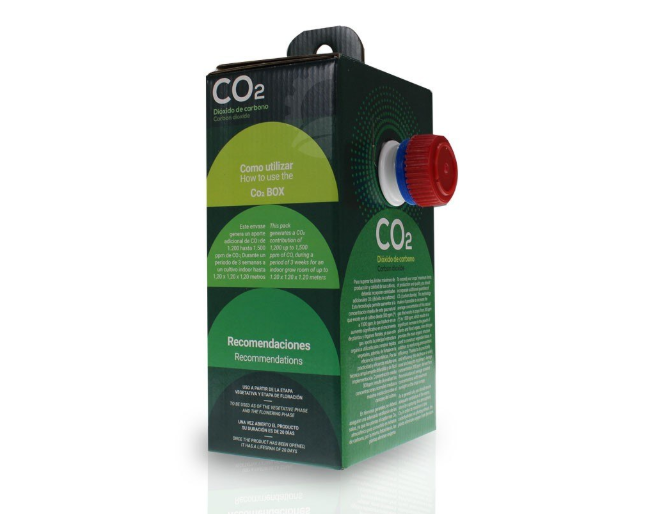
CO₂ – turbocharging your yields
CO₂ is fuel for photosynthesis.
Standard atmospheric CO₂ levels: 350–450 ppm
In indoor cultivation:
700–1200 ppm – visible yield increase
1500 ppm – commercial maximum
? Does CO₂ disappear when the fan runs?
Not completely. CO₂ is heavier than air and sinks to the bottom, so it doesn’t escape easily.
? When does CO₂ make sense?
you use strong LED lamps
temperatures exceed 28°C
rapid plant growth
goal: more resin, denser flowers, higher yield
Recommended CO₂ solutions:
CO₂ SmartBag
CO₂ EuroBoost
CO₂ BoostBuddy
Simple, passive systems ideal for home cultivation.
Humidity – a balance that determines success
Ideal humidity
50–70% – optimal range
80% – acceptable only for clones
below 45% – slows growth
above 70% in flowering – high risk of mold
Excess humidity:
❌ delays substrate drying
❌ causes root rot
❌ supports botrytis on buds
❌ hides early issues
If plants yellow despite feeding, remove the root ball from the pot and inspect the root:
white and firm – healthy
yellow/brown with rotten smell – rot
Solution:
✔️ larger pot
✔️ lighter substrate
✔️ better airflow
✔️ longer drying period
pH – the gatekeeper of nutrient absorption
Temperature may be the engine, but pH is the gearbox.
Incorrect pH = nutrients cannot be absorbed even if present.
| Substrate | Optimal pH |
|---|---|
| Soil | 6.2 – 6.8 |
| Coco | 5.5 – 6.2 |
| Hydroponics | 5.5 – 5.9 |
Even a slight deviation leads to reduced yield.
Summary – Part Five
✔️ temperature controls metabolism
✔️ humidity affects root health
✔️ CO₂ increases yield by up to 20–40%
✔️ pH determines nutrient uptake
✔️ fresh air is as important as lighting